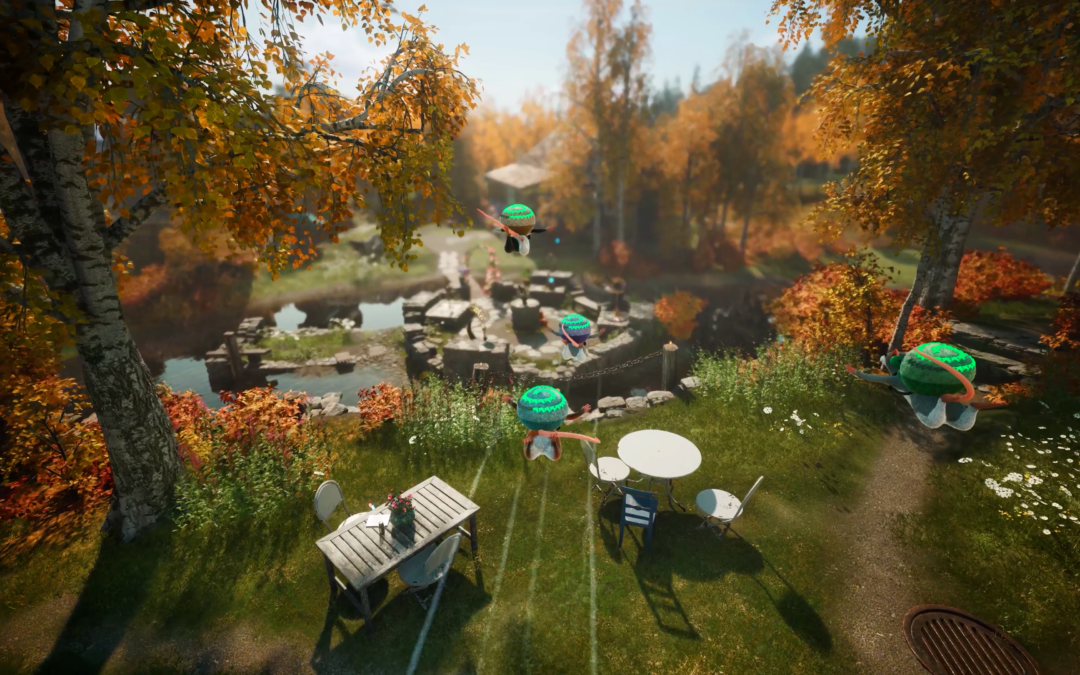
Hela: Of Mice & Magic supports one to four players through two-player local split-screen, up to four players online, and drop-in/drop-out flexibility that lets anyone join or leave mid-session without restarting progress. A built-in Shade System calls upon magical echoes to replace absent players, allowing a duo to solve puzzles meant for four. If your household is determining if this suits your specific arrangement, the brief answer is yes with one important trade-off to consider before purchasing.
Hela co-op supports up to four players online and two-player local split-screen.
Key Takeaways
- Hela supports up to four players online and two-player local split-screen.
- Drop-in co-op lets friends join or leave without restarting the session.
- The Shade System fills missing player slots with magical echoes.
- Puzzles tuned for four mice can feel less intuitive with fewer players present.
- Hela launches in 2026 on PC, PlayStation, Xbox, and Nintendo Switch 2.
A Tiny Mouse, a Fading Forest, and a World Built for Sharing
You play as a mouse familiar helping a kind witch tend a Scandinavian forest that’s slowly losing its magic. Hela: Of Mice & Magic is an open-world exploration and puzzle adventure from Windup, a studio based in Umeå, Sweden, with shared creative leadership from the team behind Unravel, published by Knights Peak. The forest is hand-crafted and full of animals waiting to be befriended.
The world rewards wandering. You swing and glide through the canopy with your Froggy backpack, forage ingredients, brew remedies, and slowly restore what the forest has lost. There’s no punishment for going the wrong way. Curiosity is the compass.
This guide focuses on the co-op design, because the question most families and friend groups ask before wishlisting is simple: will this work for our group? The answer is yes, with one honest nuance worth knowing before you buy.
Hela content generated over roughly 140 million organic views on social media (Kinda Brave Entertainment Group AB (publ), 2026), driven by creators sharing gameplay with their communities, organic reach built by players who found the forest and wanted others to see it too.
How does drop-in co-op actually work in Hela, and can players join or leave without disrupting the session?
Drop-in/drop-out co-op in Hela means any player can join an active session or leave it at any point, and the world keeps going. No one gets kicked back to a title screen. No progress disappears. A friend appears in your forest as a second mouse, and the two of you keep moving.
Many co-op games punish mid-session exits with session resets or progress locks. Hela treats player count as something fluid. A parent who needs to step away can leave. A sibling who wanders in can join. The forest adapts.
The game supports two-player local split-screen and up to four players online. Four-player local split-screen isn’t available, so if your household has three or four players who all want to play together in the same room, you’ll need to move to online. That’s worth knowing before gathering everyone around one TV.
Playing together in Hela is about shared discovery. You’re not assigning tasks or covering lanes. You’re two or three or four mice moving through the same world, finding things, and working together to heal what’s broken.
What is the Shade System, and how does it let solo players or short-staffed groups handle puzzles built for more mice?
The Shade System in Hela: Of Mice & Magic summons magical echoes, called Shades, to stand in for missing players. When a puzzle requires three mice and only one player is present, Shades fill the empty positions. Solo players can complete the entire game because of this system.
The Shade System lets solo players complete the full game without other players present.
If your group is a duo attempting a four-mouse puzzle, Shades fill the gap. If one child wants to play while a parent watches, Shades handle the rest. The system is built on the same principle as the open world: you shouldn’t be locked out of content because your group is small.
Shades activate automatically when player count falls below what a puzzle expects. They’re woven into the world’s logic, framed as magical helpers rather than a mechanical concession. That framing keeps the heart of the experience intact for solo adventurers.
For a family with younger players who might step away mid-session, or a solo player who wants to see everything the forest holds, the Shade System is a genuine reason to feel confident about picking the game up.
How does two-player local split-screen compare to four-player online, and which mode suits which kind of group?
Two-player local split-screen puts each player in control of their own mouse, with the screen divided between two viewpoints of the same world. Four-player online keeps each player on their own full screen, connected over the internet. Both modes support drop-in and drop-out.
A hands-on preview from Checkpoint Gaming in June 2026 found two-player split-screen feeling purpose-built for pairs. The screen division felt natural rather than cramped, which reflects a deliberate design choice: split-screen in Hela wasn’t added as an afterthought. The two-player experience was treated as a primary way to play.
For households with two players on the same couch, local split-screen is the right mode. For groups of three or four players, online is where you get everyone together.
| Mode | Player Count | Best For | Drop-In Support |
|---|---|---|---|
| Local Split-Screen | Two players | Couch co-op pairs | Yes |
| Online Multiplayer | Up to four players | Groups of three or four | Yes |
| Solo with Shades | One player | Single players, young children | N/A |
The Honest Nuance: Puzzles, Player Count, and What to Expect
Some puzzles in Hela are designed for four mice. That means four pressure points to hold simultaneously, or four positions to occupy at once. When fewer players are present, those puzzles can feel less intuitive. This isn’t a flaw. It’s a trade-off, and it’s worth naming honestly.
Checkpoint Gaming’s June 2026 hands-on noted that puzzles requiring more than two mice can feel fiddly when you’re short-staffed. Shades fill the gaps mechanically, but they don’t always replicate the physical satisfaction of four players working in sync. A duo solving a four-mouse puzzle is doable. It may just take more patience and a willingness to experiment with Shade positioning.
For families with two players, the honest expectation is this: most of the experience will feel excellent. The exploration, the brewing, the animal friendships, the moment-to-moment discovery. All of it scales beautifully to two. Occasional puzzles will ask more of you, as they do in most co-op games, and Hela gives you the tools to get through.
If one player in your group is picking up a controller for the first time, Hela’s physics-based puzzles rarely have one correct solution. You poke at the world until something shifts. That approach rewards patience over precision, which means a mixed-skill group can share the same session without one player holding the other back.
Built for Every Kind of Player: Exploration, Puzzles, and Playfulness
Three pillars carry every moment in Hela: Playfulness, Exploration, and Heart. Each one shows up in the mechanics, not just the marketing.
Playfulness lives in your Froggy backpack. You swing across gaps, glide over clearings, and grapple up tree trunks. The forest is a physical playground, and the physics invite experimentation. There’s almost always a way to get somewhere you weren’t supposed to reach yet.
Exploration is baked into the structure. No mandatory objectives push you along. You follow curiosity: a distant light in the trees, an animal that bolts when you approach, a patch of unusual flowers worth foraging. The forest keeps secrets and rewards the players who wander.
Heart runs through the story. Befriending animals isn’t a side activity. Brewing remedies for the witch isn’t a chore. These are the actions that slowly return colour to a world that’s been fading, and that emotional thread holds across solo play and co-op equally, because the forest doesn’t care how many mice are tending to it.
Showcases, Audiences, and Why Hela Belongs in the Family Game Conversation
Hela has appeared at the MIX Summer Game Showcase, the Green Games Showcase, and Wholesome Direct 2026. Each placement tells you something about the intended audience.
Wholesome Direct is a curated showcase for games built around heart-warming, non-violent experiences. Inclusion there isn’t automatic. It signals that the game was evaluated and found to genuinely serve players who want something kind.
Hela reached one million wishlists before its 2026 launch. The organic social reach has been equally substantial, with content creators worldwide helping audiences discover the forest on their own terms. That reach reflects real curiosity from players who found the game and wanted to share it.
Windup, the studio behind the game, brings shared creative leadership from the team that made Unravel, a spiritual successor with its own distinct story rather than a sequel. That lineage signals craft and care, without overpromising what the game is.
Platforms, Release Window, and How to Stay Ready
Hela: Of Mice & Magic launches in 2026 on PC via Steam and Epic Games Store, PlayStation, Xbox, and Nintendo Switch 2. No specific quarter has been announced yet, so wishlisting on your preferred platform is the best way to get notified the moment a date is confirmed.
Wishlisting on your preferred platform means you’ll know the moment a release date lands. It also signals to the team that there’s a household waiting for them.
If your household is two players on a couch, local split-screen is your mode. If your group is three or four players spread across locations, gather online. And if one of you needs to step away mid-session, the forest keeps going. A second mouse will appear when they’re ready to return.
Frequently Asked Questions
Is Hela: Of Mice & Magic out yet, and when can we play?
Hela: Of Mice & Magic is releasing in 2026 on PC via Steam and Epic Games Store, PlayStation, Xbox, and Nintendo Switch 2. No specific date within 2026 has been announced publicly. Wishlisting on your platform of choice is the best way to get notified the moment a date is confirmed by the publisher, KnightsPeak.
Can you play Hela with two players on the same couch?
Yes. Hela: Of Mice & Magic supports two-player local split-screen, where each player controls their own mouse on a divided screen. A hands-on preview from Checkpoint Gaming in June 2026 described the split-screen experience as feeling purpose-built for pairs, with the screen division comfortable rather than cramped.
What happens if a player needs to leave mid-session?
Drop-in/drop-out co-op means any player can leave at any point without forcing a session restart or causing progress loss. The remaining player continues in the world, and a friend can rejoin when they’re ready. The Shade System can also fill the absent player’s role in puzzles until they return.
Are the puzzles fun with just two players, or do you really need four?
Two-player co-op works well throughout most of Hela. The Shade System fills in for missing mice during puzzles that require more than two players. As Checkpoint Gaming noted in June 2026, some four-mouse puzzles can feel less intuitive with fewer players, but the game remains fully completable and enjoyable at any player count.
Is Hela suitable for younger or first-time players?
Hela: Of Mice & Magic features physics-based puzzles with no single correct solution, a self-paced open world with no mandatory objectives, and no violence. The Shade System reduces friction for younger players navigating multi-mouse puzzles. Mixed-skill groups, like a seasoned player paired with a child, can share the same session without one holding the other back.

Max Page is a visionary and a leading expert in the realm of Android app development, particularly at the intersection of AI and IoT technologies. As the founder and principal author of Agiledroid.com, Max has established himself as a thought leader in harnessing the power of artificial intelligence to revolutionize Android applications.